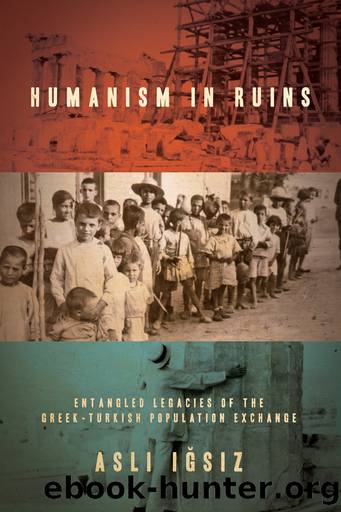
Humanism in Ruins by Aslı Iğsız
Author:Aslı Iğsız [Iğsız, Aslı]
Language: eng
Format: epub
Publisher: Stanford University Press
Published: 2018-11-14T16:00:00+00:00
The Turkish-Islamic Synthesis and Coexistence after the 1980 Military Coup
If, therefore, conclusions can be drawn from military violence, as being primordial and paradigmatic of all violence used for natural ends, there is inherent in all such violence a lawmaking character.
Walter Benjamin, âCritique of Violence,â 1921
THE TURKISH-ISLAMIC SYNTHESIS is a political paradigm that has marked modern Turkeyâs history. Demographically and discursively, it has informed a variety of policies such as segregative biopolitics, assimilation, absorption, and dispossession. As a discourse, it draws from paradigms of historicist humanism in an attempt to trace the origins and genealogies of peoples in Turkey, with differing emphases on Islam and Turkishness depending on the context. For example, the First Turkish National History Congress, organized in 1932, is commonly referred to as an important platform where Turkish national history was propounded.95 The conference presentations also included papers on the contributions of the Turks to Islamic civilizationâa move that is very much on par with the dominant paradigms of historicist humanismâin which Léon Cahun, the nineteenth-century French Orientalist who wrote on the subject, was also cited.96
The efforts to generate a Muslim majority and then Turkifyâi.e., assimilateâthem and secularize them were very salient. Those who could not be assimilated were killed or subjected to a discipline-and-punish campaign of violence on the one hand and segregative biopolitics on the other. The 1923 exchange embodied such policies par excellence. Further, as sociologist Ayhan Aktar has demonstrated, the Turkification of the economy was closely related to the 1923 population exchange.97 The interpretations of the Turkish-Islamic synthesis differed depending on the context, and the paradigm itself took different forms across time and space. Today, however, it is commonly associated with the 1980 military coup.
The Turkish-Islamic synthesis was officially included in the 1983 National Cultural Policy Report prepared in the aftermath of the 1980 military coup98âan era which also marks the last decade of the Cold War. The coup dâétat mainly targeted what the military called âdegenerateâ or âdeviantâ ideologiesâwhich implied Marxism or any faction associated with it.99 The 1983 report opens with a message by the minister of state and deputy prime minister of the military junta government, Turgut Ãzal.100 A former World Bank employee (1971â1973), Ãzal implemented the IMFâs policies in Turkey; he would later become the first elected civilian prime minister after the coup and, in 1989, the president of Turkey.101 In his June 9, 1982, message to the Special Committee of Experts who prepared the report, Ãzal states that development must proceed through a consideration not only of the economy but also of the human (beÅerî mülahazalar).102 This is why, he states, culture is important and needs to be incorporated into education: to ensure development. In referring to what he calls UNESCOâs definition of culture, Ãzal also identifies culture as the consciousness of the historical development of a group. This identification is embedded the 1983 Turkish National Cultural Policy Report.103
The emphasis on culture as integral to economic development was not Ãzalâs invention. It was previously articulated in a UNESCO document entitled Cultural Policy: A Preliminary Study.
Download
This site does not store any files on its server. We only index and link to content provided by other sites. Please contact the content providers to delete copyright contents if any and email us, we'll remove relevant links or contents immediately.
| Anthropology | Archaeology |
| Philosophy | Politics & Government |
| Social Sciences | Sociology |
| Women's Studies |
The remains of the day by Kazuo Ishiguro(9220)
Tools of Titans by Timothy Ferriss(8593)
Giovanni's Room by James Baldwin(7546)
The Black Swan by Nassim Nicholas Taleb(7274)
Inner Engineering: A Yogi's Guide to Joy by Sadhguru(6889)
The Way of Zen by Alan W. Watts(6732)
The Power of Now: A Guide to Spiritual Enlightenment by Eckhart Tolle(5923)
Asking the Right Questions: A Guide to Critical Thinking by M. Neil Browne & Stuart M. Keeley(5895)
The Six Wives Of Henry VIII (WOMEN IN HISTORY) by Fraser Antonia(5608)
Astrophysics for People in a Hurry by Neil DeGrasse Tyson(5276)
Housekeeping by Marilynne Robinson(4580)
Double Down (Diary of a Wimpy Kid Book 11) by Jeff Kinney(4407)
Ikigai by Héctor García & Francesc Miralles(4388)
Skin in the Game by Nassim Nicholas Taleb(4381)
12 Rules for Life by Jordan B. Peterson(4376)
The Ethical Slut by Janet W. Hardy(4348)
The Art of Happiness by The Dalai Lama(4232)
Skin in the Game: Hidden Asymmetries in Daily Life by Nassim Nicholas Taleb(4124)
Walking by Henry David Thoreau(4075)
